I’d like to give a shout out to Electrical Safety First’s plug checker.
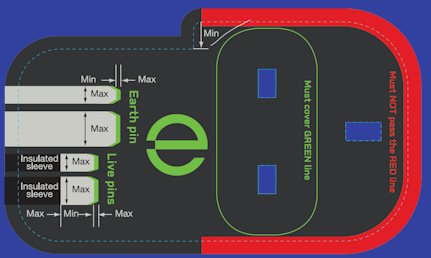
It’s a little laser-cut plastic card that enables you to quickly determine if you’ve got a non-compliant mains plug.
You can buy them here.
I’d like to give a shout out to Electrical Safety First’s plug checker.
It’s a little laser-cut plastic card that enables you to quickly determine if you’ve got a non-compliant mains plug.
You can buy them here.
One for each repair service in Scotland. Good site and another reference to recalled goods which repairers should check just in case.
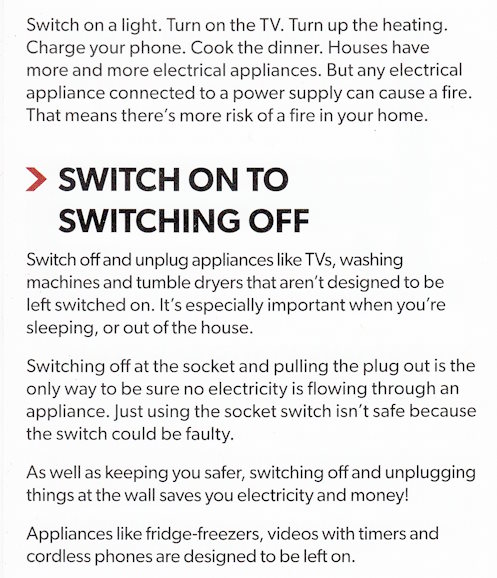
At our most recent event, the fire service turned up unannounced. They went around handing out leaflets on electrical safety. So far, so laudable. However, I have to take issue with some of the advice that was in their propaganda.
The back of their leaflet was marked v2.3 November 2020. It says to unplug televisions and washing machines:
I think this is effectively a misunderstanding and overreaction to a number of television fires which occurred in the United States in the 1970s. Televisions sold in the last fifteen years or so contain a switched mode power supply board, a logic board, and the panel itself, which is just some LEDs. It doesn’t seem to me to be more of a death trap than anything else.
Now my second point. “Switching off at the socket and pulling the plug out is the only way to be sure no electricity is flowing through an appliance”. Well, according to the laws of physics, yes, pulling the plug will indeed have that desired effect. Here we get to the dubious claim: “Just using the socket switch isn’t safe because the switch could be faulty.”
Well, I find this rather alarmist. The switches on the electrical sockets in my house could be faulty. How could that be? Why? Water ingress? Physical damage? It’s all a bit spurious.
British domestic electrical sockets and plugs are widely regarded as being the safest in the world. I think the suggestion that a switch “could be faulty” is unhelpful and disproportionality alarmist. If it causes unnecessary fear to the elderly, then it shouldn’t be made. If it’s not backed up by facts, it shouldn’t be made.
“Switching off and unplugging things at the wall saves you electricity and money!”. Well, probably not. I don’t know what the standby current of a telly is and I couldn’t calculate what you could save in monetary terms by unplugging the thing over say a year, but I’d be surprised if it were more than tuppence ha’penny. I don’t think subjecting an appliance to repeated unnecessary thermal and electrical stresses is wise.
Finally we get to the statement “Appliances like fridge-freezers, videos with timers and cordless phones are designed to be left on”. Okay, so the suggestion is there’s a difference between a washing machine and a fridge-freezer. The latter is fine, but the former is a potential death trap. (As for “videos with timers” – what are they? I chucked my VHS recorder about twenty years ago).
What do you reckon?
Having recently been looking for a flat in Edinburgh for my daughter, I was shocked to see so many still with sockets in the skirting boards and old wire fuses in CUs. So it may be the wiring that’s more at risk. Equally the 50 hz power can vibrate the screws in terminals can it not? Or is that a myth.
A lot of washing machines, tumble dryers and the likes are wired to wall switches and unplugging doesn’t make sense as you have to move them. Equally some questionable kitchen fitters put sockets under the sink…
A few years ago, you could have fried an egg on my virgin media hub. Glad I ditched it. On what I thought was standby, it was busy at night doing updates etc. so TVs might have SMPS but some other bits may be less well designed. Subwoofers, soundbars, video streaming boxes, etc.
We had a Bose CD radio in a few months back and the customer had never turned it off. Bedside radio. When he did, it wouldn’t come back on. Well for him. For us, we left it to warm up and the capacitors inside eventually got to a point where it wouldn’t work again. SO it was working with defective components and only showed a fault when it was off for enough time to cool down. That was a big re-cap job…
It does seem stupid to suggest that a TV with a standby mode isn’t designed to be left plugged in. Along with any other device that has some form of power switch built into the device.
Like I suspect most people, I don’t routinely unplug electrical equipment. I do tend to switch off quite a bit more when leaving the house for an extended period, however some things (like my router and home server) stay on, because they are performing functions that I desire to continue in my absence. I think suggesting that people unplug everything when they’re not using them is a really good way to get people to ignore everything you’re saying.
As for 50Hz mains vibrating screws loose. I think that’s unlikely. Clearly there is some physical movement caused, especially in things like transformers, however I’d expect thermal expansion and contraction to have a far bigger impact on fixings. Vibrations clearly can cause things to come loose and or cause damage, but there needs to be sufficient amplitude and also you’d typically need the oscillation to be close to or match the natural frequency (or arguably one of its harmonics) of the part in question to have any chance of causing issues.